
Misophonia: What the Research Actually Shows
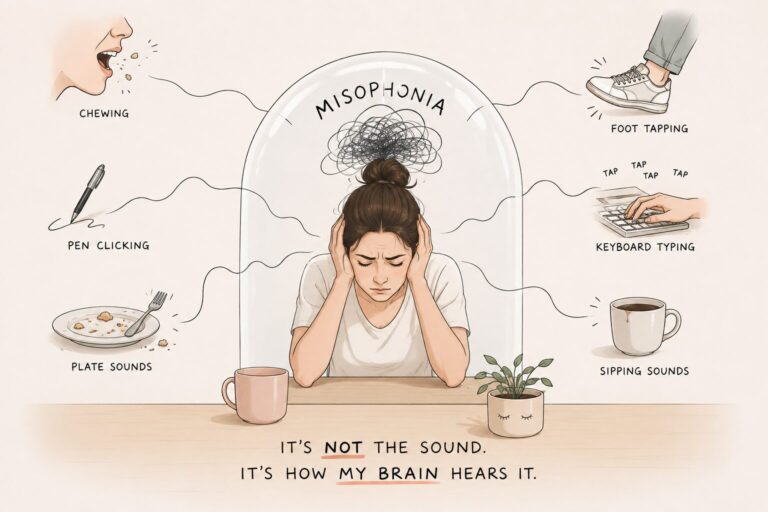
If a specific sound — chewing, breathing, a pen clicking — triggers a reaction in you that feels closer to rage than irritation, you’re not overreacting, and you’re not alone. This is misophonia, and it’s one of the more misunderstood conditions in mental health, partly because the science is still catching up to the experience.
This article lays out what’s actually known about misophonia right now: what it is, what happens in the brain, and what the research does and doesn’t support.
What Is Misophonia?
Misophonia literally means “hatred of sound.” That’s a slightly misleading name, because people with misophonia aren’t bothered by sound in general — loud concerts or noisy traffic don’t usually trigger a reaction. The problem is specific: particular sounds, almost always ones made by other people’s bodies, produce an intense, immediate, and disproportionate emotional response.
In 2022, an international group of researchers and clinicians published the first formal consensus definition, describing misophonia as a disorder of decreased tolerance to specific sounds or the stimuli associated with them. That consensus mattered, because before it, different research teams were using different criteria — which made it hard to compare studies or build a solid evidence base.
The response itself is well documented. It typically follows a pattern: irritation or disgust, escalating almost instantly into anger, sometimes followed by an urge to escape the sound or confront its source. Some people also experience anxiety, panic, or a strong impulse to avoid situations where a trigger might occur.
Is Misophonia a Recognized Disorder?
Here’s where a lot of online content overstates the science, so it’s worth being precise: misophonia is not currently listed in the DSM-5 or the ICD-11. There is no official diagnostic code for it.
That doesn’t mean it isn’t real, and it doesn’t mean it’s “just” a preference or a bad habit. It means the condition is still working its way through the slow, deliberate process of formal medical classification. Researchers first proposed misophonia as a distinct psychiatric disorder in 2013. In December 2024, the International Misophonia Foundation submitted a formal proposal to the World Health Organization requesting ICD classification, citing the growing neurophysiological evidence. That process is ongoing.
So the accurate way to describe misophonia right now is: a condition with a measurable neurological basis that is not yet formally classified as a disorder. That’s a meaningful distinction, and it’s one worth knowing if you’re trying to understand your own experience or explain it to someone else, a formal diagnosis isn’t required for the condition to be legitimate, but it’s also not accurate to claim a classification that doesn’t yet exist.
What Happens in the Brain?
This is where the research has moved fastest. The first fMRI study of misophonia, led by Kumar and colleagues in 2017, found that trigger sounds produced heightened activity in the anterior insular cortex (AIC) a brain region involved in processing disgust, pain, and interoception (your sense of your body’s internal state). That same study found unusually strong connectivity between the AIC and other regions, including the anterior cingulate cortex, hippocampus, and amygdala areas tied to emotional memory and threat response.
Later studies extended this. Some found increased connectivity between the auditory cortex and the motor regions responsible for orofacial movement the muscles used in chewing and lip-smacking which may explain why eating sounds are such a common trigger. Others found evidence that the prefrontal cortex, which normally helps regulate emotional reactions, appears less able to dampen the response once it starts.
In plain terms: in a misophonic brain, a specific sound gets flagged by the brain’s salience network, the system that decides “this matters, pay attention” and routed straight into circuits that handle disgust and threat, with weaker top-down regulation to slow the reaction down. That’s a genuinely different pattern of brain activity, not a matter of willpower or tolerance.
Physiological studies back this up outside the scanner too: people with misophonia show measurably higher heart rate and skin conductance (a marker of physical arousal) when exposed to trigger sounds, compared to people without the condition.
Common Triggers and Symptoms
The most frequently reported triggers are:
- Oral sounds — chewing, swallowing, lip-smacking, slurping
- Nasal sounds — breathing, sniffing
- Repetitive sounds — pen clicking, tapping, keyboard typing
- Visual triggers — in some people, simply seeing the repetitive movement that produces the sound (a jaw moving, a leg bouncing) is enough
Sounds made by strangers are often more tolerable than the same sound made by a close family member, a detail that shows up consistently in research and that many people find genuinely puzzling about their own reaction.
Common symptoms include a surge of anger or disgust, a strong urge to leave the room or stop the sound, muscle tension, a racing heart, and, because the reaction can feel so disproportionate to the trigger, shame or self-criticism afterward. Over time, many people begin avoiding situations where triggers are likely, which can affect relationships, shared meals, workplaces, and classrooms.
Misophonia vs. Related Conditions
Misophonia is often confused with two other conditions:
- Hyperacusis is a reduced tolerance to sound volume in general, loud or even moderate everyday sounds feel physically painful. It’s not about specific sounds.
- Phonophobia is a fear of sound, often anticipatory, and can occur alongside migraine or anxiety disorders.
Misophonia is distinct from both: the trigger is specific, the primary emotion is anger or disgust rather than fear, and the reaction is about the meaning or pattern of a sound rather than its loudness.
Where the Research Stands
A few things are worth being honest about, because overstating certainty is its own kind of disservice:
- The evidence base is still young, the term was only coined in 2001, and rigorous neuroimaging has really only developed over the last decade.
- Findings are consistent enough to say misophonia has a real, identifiable neurological signature, but the field hasn’t settled on a single explanatory model.
- No blood test, brain scan, or questionnaire can currently diagnose misophonia on its own. Screening tools like the Amsterdam Misophonia Scale exist, but none is yet validated as a definitive diagnostic standard.
- Because misophonia lacks formal classification, treatment approaches are still being tested and compared rather than standardized. Cognitive behavioral approaches, including trigger-response retraining, applied relaxation, and attention-shifting techniques — currently have the strongest research support, though the evidence base here is also still growing.
The Bottom Line
Misophonia sits in a genuinely interesting, and genuinely frustrating place, in mental health research: real enough to show up on a brain scan, common enough to affect millions of people, and still without an official diagnosis. If sound triggers a reaction in you that feels bigger than the situation warrants, that’s not a character flaw. It’s a documented pattern with a documented basis in how your brain processes sound — and it’s an active, growing area of research, not a dead end.
At Reborn Clinic, we work with misophonia using an integrative CBT approach grounded in the current research on trigger-response patterns and emotion regulation. If these reactions are shaping how you eat with family, work alongside others, or move through your day, that’s worth addressing with structured support — not something to just manage alone indefinitely. Get in touch to book a session.
References
Swedo, S. E., et al. (2022). Consensus definition of misophonia: A Delphi study. Frontiers in Neuroscience, 16, 841816. — backs the “disorder of decreased tolerance to specific sounds” definition.
Schröder, A., Vulink, N., & Denys, D. (2013). Misophonia: Diagnostic criteria for a new psychiatric disorder. PLoS ONE, 8(1), e54706. — backs the “not yet classified, first proposed in 2013” point.
Kumar, S., et al. (2017). The brain basis for misophonia. Current Biology, 27(4), 527–533. — backs the whole brain/AIC section, your strongest evidence claim.
Jager, I., de Koning, P., Bost, T., Denys, D., & Vulink, N. (2020). Cognitive behavioral therapy for misophonia: A randomized clinical trial. Depression and Anxiety, 37(2), 137–144.