CBT for Misophonia: Does It Actually Work?
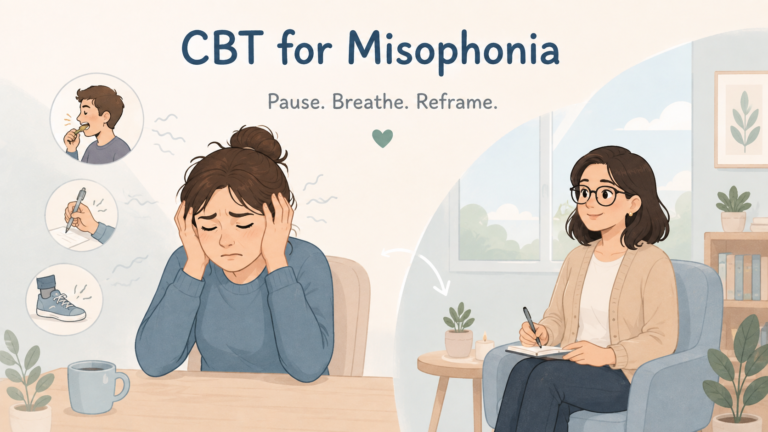
CBT for misophonia is currently the only treatment approach with evidence from a randomized controlled trial behind it. That’s a meaningful distinction in a field where most treatment claims still rest on case reports. But it’s worth being precise about what that evidence actually supports, and it isn’t a cure. It’s a structured way of reducing how much a trigger sound controls your reactions and your life.
Here’s what the treatment actually involves, what the research found, and where the honest limits are.
Why CBT Targets the Response, Not the Sound
Misophonia researchers, particularly the Amsterdam UMC group that has produced most of the trial data on this condition, work from a conditioning model, and it’s this model that shapes how CBT for misophonia is structured: a neutral sound (the trigger) becomes paired with an intense emotional and physical reaction, such as anger, disgust, or a spike in heart rate, until the sound itself reliably sets off the response, almost automatically. Because the sound and the reaction are learned as a pair, the treatment logic follows: you can’t remove the sound from someone’s environment forever, but you can work on the pairing itself.
This is why CBT for misophonia doesn’t center on avoiding trigger sounds, and it isn’t exposure therapy in the way that’s used for phobias. In fact, one of the more counterintuitive findings in this research is that plain exposure, meaning just repeatedly confronting the trigger sound, has occasionally made symptoms worse rather than better in misophonia specifically, unlike its track record with fear based conditions. That single finding is a large part of why misophonia protocols look different from standard anxiety disorder CBT.
What the Treatment Actually Involves
The protocol used in the only published randomized trial of CBT for misophonia (Jager et al., 2020) combined group psychotherapy with psychomotor therapy across seven weekly sessions plus a follow up. It had four core components:
- Task concentration exercises: redirecting attention away from hyperfocusing on the trigger sound and back onto the task at hand, since misophonia involves a strong attentional lock in to trigger stimuli.
- Stimulus manipulation: controlled, gradual exposure to trigger sounds under conditions the person can influence, for example adjusting a recorded sound’s volume or pace themselves, paired with counterconditioning rather than passive exposure alone.
- Arousal and stress reduction: relaxation based techniques aimed at lowering the physical spike (heart rate, skin conductance) that accompanies the trigger response.
- Positive affect labeling: a cognitive technique for reframing the emotional charge attached to the trigger, rather than letting anger or disgust run unchallenged.
Two additional elements were built in: re-evaluating rigid personal rules, particularly around eating, since food related sounds are the most common trigger, and a family psychoeducation session, since misophonia reliably affects the people closest to the person experiencing it, not just the individual.
What the Research Actually Shows
The evidence base for CBT for misophonia is small but real. An earlier open label trial from the same research group (Schröder et al., 2017) tested this approach in 90 patients: 48% showed clinically meaningful improvement after eight sessions, with an average 4.5 point reduction on the Amsterdam Misophonia Scale.
The 2020 randomized trial built on that. Patients assigned to CBT for Misophonia showed a statistically significant reduction in misophonia symptoms compared to a waitlist control group, with a large effect size. Thirty seven percent showed clinically observed improvement versus zero percent on the waitlist. Importantly, the improvement wasn’t a short term blip. It was maintained at one year follow up, after the waitlist group crossed over and also received treatment.
That’s genuinely encouraging data. It’s also, so far, the only randomized trial that exists for this condition. No study has yet compared CBT head to head against another active treatment, sample sizes remain modest, and the mechanisms of change, meaning which specific component is doing the work, aren’t yet understood. Researchers are explicit about this in their own papers: it isn’t yet known which parts of the protocol matter most.
Management, Not a Cure
This is the part that gets flattened in a lot of online content, and it shouldn’t be: CBT for misophonia is not currently supported by evidence as a cure, and no credible researcher in this field is claiming it is.
What the research supports is symptom reduction and improved functioning: being able to eat with family, work in shared spaces, or sit through a meeting without the reaction taking over. It does not support the claim that the underlying trigger response pairing is permanently eliminated. Misophonia’s conditioned response can resurface, particularly under stress or with new triggers, and the skills learned in CBT (task concentration, arousal reduction, reframing) are tools for managing that response on an ongoing basis, not a one time fix.
This distinction matters for anyone considering treatment. Coming in expecting to never react to a trigger sound again sets up disappointment with a treatment that is, by the actual data, still genuinely helpful. Coming in expecting a set of durable skills for managing a real, brain based response is a more accurate, and more sustainable, starting point.
Reborn Clinic offers two ways to work with misophonia using this same evidence based approach. If you’d rather start on your own terms, there’s a self paced online CBT for misophonia course you can work through whenever it suits you. If you’d rather work through it with someone directly, one to one therapy and consultation sessions are also available. Either way, the goal isn’t to promise you’ll never react to a trigger sound again. It’s to give you practical, evidence based tools for managing that reaction so it stops running your day. Contact me to book a session or find out more about the course.
References
Jager, I. J., Vulink, N. C. C., Bergfeld, I. O., van Loon, A. J. J. M., & Denys, D. A. J. P. (2020). Cognitive behavioral therapy for misophonia: A randomized clinical trial. Depression and Anxiety, 38(7), 708–718.
Schröder, A., Vulink, N., van Loon, A., & Denys, D. (2017). Cognitive behavioral therapy is effective in misophonia: An open trial. Journal of Affective Disorders, 217, 289–294.
Jager, I., Vulink, N., van Loon, A., van der Pol, F., Schröder, A., Slaghekke, C., & Denys, D. (2022). Synopsis and qualitative evaluation of a treatment protocol to guide systemic group cognitive behavioral therapy for misophonia. Frontiers in Psychiatry, 13, 794343.
Schröder, A., Vulink, N., & Denys, D. (2013). Misophonia: Diagnostic criteria for a new psychiatric disorder. PLoS ONE, 8(1), e54706.