
Burnout Symptoms Start Before You Collapse
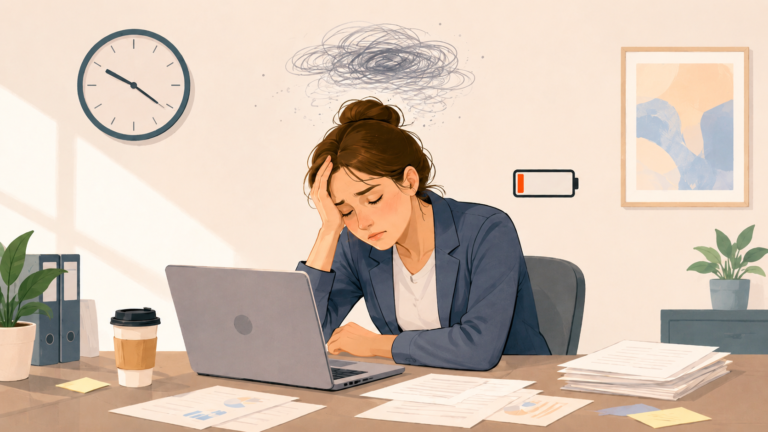
Most people describe burnout the way they’d describe a bad week: tired, wired, fed up. But the research tells a more precise story. Burnout symptoms aren’t simply stress turned up loud. They are associated with measurable changes in stress regulation, autonomic functioning, sleep, cognition and, in some studies, brain structure and function. Understanding what is happening beneath the surface changes how we think about recovery, and explains why advice like “just take a holiday” so often fails.
A Syndrome, Not a Bad Mood
The World Health Organization gave burnout a more detailed definition in ICD-11 in 2019, but notably did not classify it as a mental health diagnosis. It is described instead as an occupational phenomenon, a syndrome resulting from chronic workplace stress that has not been successfully managed. That distinction matters, because burnout symptoms are not simply evidence that an individual has failed to cope; they emerge in the context of chronic occupational stress.
The WHO’s definition describes three interlinked features. There is exhaustion, not the ordinary tiredness that lifts after a good night’s sleep, but a depletion that persists. There is a growing cynicism or mental distance from one’s job, a sense of no longer caring the way one used to. And there is an erosion of professional efficacy, a conviction that nothing one does really makes a difference anymore. What separates burnout symptoms from ordinary stress is not one biological threshold, but a persistent occupational pattern involving exhaustion, cynicism and reduced efficacy. Research by Maslach and Leiter also points to recurring mismatches in workload, control, reward, community, fairness and values.
What Is Happening in the Body
Here it is worth being careful, because much of what circulates online overstates the science. The popular account holds that chronic stress exhausts the adrenal glands and crashes cortisol. The actual evidence is messier. Several systematic reviews of the hypothalamic-pituitary-adrenal axis, the body’s central stress-response system, report inconsistent findings in people with burnout: some studies show blunted cortisol reactivity, others show elevated levels, and reviews conclude there is no reliable, reproducible cortisol signature for burnout symptoms. Cortisol remains a strong marker of an acute stress reaction, but a far weaker and more contested one for burnout specifically, and treating it as a settled biological fingerprint isn’t something the evidence supports.
There is also evidence of autonomic nervous system involvement, but not one consistent pattern. Some studies have found reduced heart rate variability and altered autonomic regulation in people with clinical burnout symptoms, while others have not found a reliable difference. Burnout symptoms have also been associated with disrupted sleep and circadian disturbance, and because sleep underpins the body’s capacity to recover, this disruption can compound nearly everything else happening physiologically.
What Is Happening in the Brain
This is one of the most interesting areas of burnout research, and one of the easiest to overstate. Neuroimaging studies of people with clinical burnout, chronic occupational stress and related exhaustion disorders have reported differences involving the prefrontal cortex, amygdala, anterior cingulate cortex, striatum and functional connectivity between stress and emotion regulation networks. But the findings are not identical across studies, and there is no established or diagnostic “burnout brain.”
In practical terms, some of these findings are consistent with weaker top-down regulation and greater stress-related reactivity, which may help explain why concentration, emotional regulation and decision-making can become harder during severe burnout symptoms. But brain scans cannot currently diagnose burnout, and we cannot assume that every person with burnout has the same structural changes. Longitudinal research suggests that at least some stress-related brain differences may partially reverse during recovery and rehabilitation.
Why This Matters, for Individuals and for Organizations
If burnout were purely a matter of mood, motivational strategies would resolve it. Because burnout symptoms emerge in the context of chronic occupational stress and are associated with changes across psychological and physiological systems, advice built on willpower alone tends to underperform. Research suggests that both individual and organizational interventions can help, while some meta-analyses, particularly in physicians, have found larger reductions from organization-directed interventions. The overall effects are still modest and vary across studies.
That is the slightly inconvenient conclusion for both sides. An individual cannot meditate their way out of a structurally unsustainable job, and no amount of personal coping skill fully compensates for conditions that keep generating the same mismatch. For organizations, this means wellness workshops are not a substitute for addressing workload, autonomy, recognition, fairness and support. For individuals, psychological tools still matter, both for recognizing the mismatch before it becomes chronic and for changing patterns that can intensify or prolong burnout symptoms. This is where a CBT-based approach earns its place: not as a substitute for changing what actually needs to change, but as a way of working with appraisals, coping behaviour, boundaries and recovery patterns.
If these burnout symptoms sound familiar, whether persistent exhaustion, a growing sense of detachment from work, or a loss of confidence in your own competence, and whether you’re navigating this yourself or supporting a team through it, a conversation with a CBT-trained practitioner can help clarify what is actually driving it and what to do next. Book a consultation with Reborn Clinic to talk it through.
References
World Health Organization. “Burn-out an ‘occupational phenomenon’: International Classification of Diseases.” 2019.
Maslach, C., and Leiter, M. P. Research programme on the Areas of Worklife model and the Maslach Burnout Inventory.
Danhof-Pont, M. B., van Veen, T., and Zitman, F. G. “Biomarkers in burnout: A systematic review.” Journal of Psychosomatic Research.
Cadegiani, F. A., and Kater, C. E. Systematic review of adrenal and HPA-axis function in burnout.
Chmiel, J., and Kurpas, D. “Burnout and the Brain: A Mechanistic Review of Magnetic Resonance Imaging Studies.”
Deligkaris, P., Panagopoulou, E., Montgomery, A. J., and Masoura, E. “Job burnout and cognitive functioning: A systematic review.” Work & Stress.
Panagioti, M., Panagopoulou, E., Bower, P., et al. “Controlled interventions to reduce burnout in physicians: A systematic review and meta-analysis.” JAMA Internal Medicine.