Cognitive Biases: How They Shape Your Mind, Relationships and Leadership
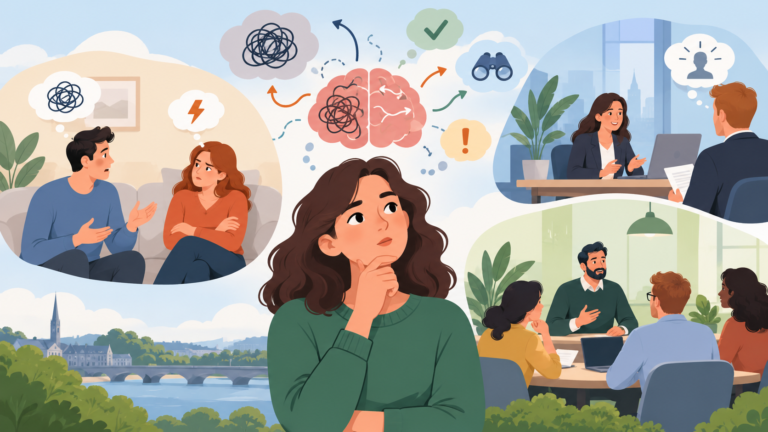
Every day you make thousands of quick judgements. Is this person trustworthy? Is that short email a problem? Most of these calls happen before you notice you are thinking at all. Psychologists call these systematic tendencies in judgement cognitive biases. Many come from heuristics, mental shortcuts that save effort but produce predictable mistakes when information is uncertain (Tversky & Kahneman, 1974). They are most likely to steer us when we rely on fast, intuitive thinking rather than slower, deliberate reasoning (Kahneman, 2011). Knowing this does not protect you. People recognise bias in others far more readily than in themselves, a pattern called the bias blind spot. In the original studies, people rated themselves as less susceptible to a range of biases than the average person (Pronin et al., 2002). Higher cognitive ability does not reduce it (West et al., 2012). Understanding cognitive biases is useful. Assuming you are free of them is not. They matter in three places in particular: your mental health, your working life and the decisions leaders make.
Cognitive Biases and Your Mental Health
Cognitive Behavioural Therapy (CBT) is built on the finding that the way we interpret events shapes how we feel and what we do (Beck, 1976). Cognitive biases are not the same as the automatic thoughts and thinking errors we work with in CBT, but they influence which interpretations arrive first and which feel convincing. Confirmation bias is a good example. Once we hold a belief, we seek, notice and remember information that fits it, and discount what does not (Nickerson, 1998). Turned inwards, this means someone who believes they are not good enough will register every mistake and quietly dismiss evidence of their competence.
Anxiety works in a similar way. People with anxiety are more likely to notice possible threats and to read ambiguous situations negatively (Mathews & MacLeod, 2005). A brief reply from a manager becomes evidence of disapproval. What keeps this going is often behaviour. Checking, avoiding and seeking reassurance bring short-term relief, but they stop the feared belief from ever being tested (Salkovskis, 1991). In CBT, we work on both sides of this loop. We separate what happened from what was concluded, then test predictions through behavioural experiments: planned actions designed to check whether a feared outcome actually happens (Bennett-Levy et al., 2004). The aim is not positive thinking. It is more accurate thinking, followed by a different response.
Cognitive Biases in the Workplace
At work, the same processes shape how we read colleagues. When someone misses a deadline, we tend to blame their character and overlook their circumstances, a pattern known as the fundamental attribution error (Ross, 1977). The popular claim that we always excuse ourselves while blaming others is weaker than often stated, as a large meta-analysis found that difference to be small and inconsistent (Malle, 2006). Hiring shows the cost clearly. Interviewers tend to form early impressions and then ask questions and interpret answers in ways that confirm them (Dougherty et al., 1994). The halo effect adds to this, as one attractive trait, such as confidence or a polished manner, colours judgement of unrelated qualities without our awareness (Nisbett & Wilson, 1977). Studying elite professional firms, Rivera (2012) found that evaluators often favoured candidates who shared their hobbies and background, and counted that similarity as “fit”. The evidence points to structure. Structured interviews, with consistent questions and agreed scoring criteria, predict job performance substantially better than unstructured ones (Sackett et al., 2022).
It is also important to be honest about limits. Bullying and unreasonable demands are not thinking errors, and Irish employers have clear duties under the Code of Practice on preventing and resolving bullying at work (Health and Safety Authority & Workplace Relations Commission, 2020).
Cognitive Biases in Leadership
In leadership, cognitive biases do not stay inside one head. They spread into the team and the culture. Janis (1982) proposed that close-knit groups can suppress doubts to protect harmony, a pattern he called groupthink. Later reviews found only mixed support for his full model (Aldag & Fuller, 1993), so it is best treated as a warning sign rather than a rule. Escalation of commitment is better supported. People tend to keep investing in failing courses of action, particularly when they feel responsible for the original decision (Staw, 1976; Sleesman et al., 2012). The planning fallacy adds optimism, as people consistently underestimate how long tasks will take (Buehler et al., 1994).
Asking people to simply be more aware is not enough. A large meta-analysis found that interventions designed to change implicit associations generally produced little change in behaviour (Forscher et al., 2019). Leaders influence the systems in which decisions are made, and better processes can reduce reliance on individual judgement alone.
What Actually Helps
Personally, start by naming the interpretation instead of treating it as fact: “I’m assuming she’s annoyed with me.” Consider at least two alternative explanations and look deliberately for evidence against your first one. If you notice yourself checking or avoiding, ask what you are preventing yourself from finding out. This is the core skill we practise in CBT, and it becomes easier with repetition. In the workplace, use structured interviews with more than one interviewer and independent scoring before any discussion. As a leader, run a premortem before major decisions: imagine the project has failed and ask the team to explain why, which makes it easier to raise concerns that would otherwise go unsaid (Klein, 2007). Collect views independently, or speak last, so your opinion does not become an anchor for everyone else (Tversky & Kahneman, 1974).
You cannot eliminate cognitive biases. You can learn to recognise them, test them and build processes that catch them before they become decisions. At Reborn Clinic, I offer online CBT psychotherapy across Ireland for anxiety, overthinking, self-doubt and work-related stress. I also run workshops for organisations and leadership teams on how cognitive biases shape decisions, communication and wellbeing at work.
References
-
Tversky & Kahneman (1974) — Heuristics and biases. Science. DOI
-
Pronin et al. (2002) — Bias blind spot. Personality and Social Psychology Bulletin. DOI
-
Nickerson (1998) — Confirmation bias. Review of General Psychology. DOI
-
Rivera (2012) — Cultural matching in hiring. American Sociological Review. DOI
-
Sackett et al. (2022) — Personnel selection validity. Journal of Applied Psychology. DOI
-
Forscher et al. (2019) — Interventions targeting implicit associations. Journal of Personality and Social Psychology. DOI